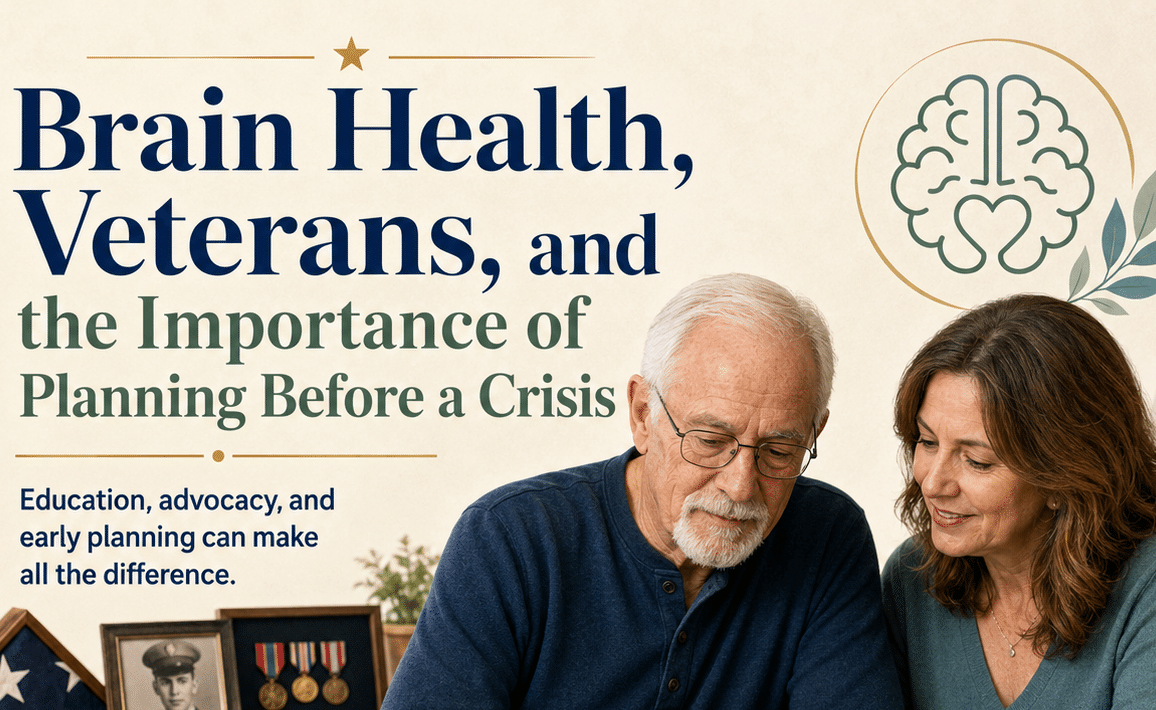
I have been trying to find the right words for Brain Health and Brain Awareness Month because this topic is so close to my heart.
Brain health touches so much of the work I do. More than 60% of the families I support are navigating some form of cognitive change, memory loss, dementia, Alzheimer’s disease, neurological decline, or the difficult decisions that come when a loved one can no longer safely manage life the way they once did.
Because of that, I am deeply passionate about education.
To me, education is one of the most powerful tools I can offer families. It gives people a place to start. It gives them language for what they are seeing. It gives them the ability to ask better questions, explore resources sooner, and make decisions before everything becomes a crisis.
Brain health is not limited by geography, class, race, age, lifestyle, privilege, or knowledge. It can touch any family. It can come through many different diagnoses and life experiences. It can affect the person living with the condition, the spouse trying to hold everything together, the adult children who are suddenly making decisions, and the caregivers who are doing their best to support everyone involved.
With a subject this meaningful, and one that touches so many generations, how do we talk about it in a way that truly matters?
For me, it starts with real stories.
I have had the honor and privilege of working with many Veterans and families from many different walks of life. And one thing I often find is that families are undereducated about where to turn when a diagnosis progresses or when care needs suddenly become more serious.
I see this often in the Veteran population.
So many Veterans and families believe that because someone served, the benefits and support they may need will simply be there when the time comes. I often hear, “I am a Veteran. I served. I have benefits.”
But what many families do not realize is that if a Veteran has not stayed connected to the VA, has not established a relationship with a local Veterans office, or has not received a disability rating, the process of accessing support can take time. In some cases, families may be months away from approvals, documentation, and decisions that could impact the type of care their loved one can receive.
I cannot emphasize this enough: please find out what benefits may be available before something goes wrong.
Build a relationship with your local Veterans Service Officer. Get connected to the VA or local Veteran resources. Ask questions while your loved one is still healthy enough to help provide information, records, history, and context. The paperwork can be overwhelming, and it is much harder to navigate when a family is already in crisis.
This is personal for me.
For the last two years, I have been an advocate for my stepdad. When I started helping him, he did not have a relationship with the local Veterans office. In fact, he really wanted to bury that part of his life. He did not talk about it. He did not expect anything from it. He simply wanted to leave it where it was.
Then he was diagnosed with Alzheimer’s disease. Five months later, he was diagnosed with prostate cancer.
That was when several bells went off for me. As a Vietnam Veteran, I knew we needed to take a closer look at his service history, his possible exposures, and whether any of his health conditions could connect him to support he had earned through his service.
What I soon learned was that the service he signed up for and the service he was ultimately asked to perform in Vietnam were not the same story.
He had been called from the Army National Guard to active-duty Army service. He went from being a radio specialist to a much more serious and emotionally difficult role assisting with the departed.
His story mattered. His records mattered. But finding the documentation to support his journey was not easy.
We were declined twice before the records were found that finally supported what he had lived through.
So if there is one thing I want families to hear, it is this: do not give up.
Find a strong Veterans Service Officer. These are people who help Veterans and families navigate the system, gather documentation, submit claims, and understand what may be available. In my experience, they are often angels on earth for families trying to make sense of an overwhelming process.
With the support of a dedicated Veterans Service Officer, and with a lot of persistence from our family, my stepdad went from no disability rating to a 100% disability rating in about 10 months. We stayed on top of the case because he needed serious care, and the support made a meaningful difference.
My stepdad had done many things right.
He took care of himself. He was active. He was highly intelligent. He had spent his life using his mind and his hands. He could fix almost anything around the farm. He could come over and repair a faucet or take on a project at the drop of a hat.
Even during cognitive testing, his intelligence showed through. He could remember math problems like the back of his hand, but struggled with other parts of the exam, like repeating a sentence forward. That is one of the heartbreaking things about brain health and cognitive decline. It does not always look the way people expect it to look.
He ate well. He cared for his body. He stayed active. Statistically, he did many things right.
But sometimes there are exposures, experiences, chemicals, trauma, and risks that we do not fully understand until years later. Sometimes the things our loved ones carried quietly can come back in ways that change everything.
I share this story for a few reasons.
First, I want families to have hope. If your loved one is a Veteran, there may be benefits, resources, or support available that could make a meaningful difference during a time of crisis.
Second, I want families to know that the system can be difficult, but there are people who can help you navigate it.
Third, I want families to understand that planning early matters.
For many of my clients, access to the right benefits or resources can be a complete difference maker. It can impact whether someone has access to private care, additional in-home support, a more appropriate living environment, or resources that help them remain safely at home longer.
In some cases, it can mean the difference between very limited care options and a more supportive, dignified plan.
This is why I do the work I do.
Families are often overwhelmed. They are trying to understand a diagnosis, manage finances, support a spouse or parent, communicate with providers, explore care options, and make emotional decisions all at once.
My role is to help families slow down, understand their options, ask the right questions, and connect with resources that may help. I cannot remove the difficulty of the journey, but I can help make the path feel less confusing and less lonely.
Brain health matters. Education matters. Planning matters. And knowing where to turn before a crisis can change what is possible for a family.
If you are caring for a loved one with memory loss, cognitive decline, Alzheimer’s disease, dementia, or a complex medical diagnosis, please do not wait until you are overwhelmed to ask for help.
If your loved one is a Veteran, please connect with your local Veterans Service Officer and begin learning what resources may be available.
And if you need support understanding senior living, care options, or how to begin the next step, I am here to cheer you on, provide tools, and help you navigate the process with compassion.
Warm regards,
April Sage
Related Posts
June 1, 2026
Not All Wounds Are Visible: PTSD Awareness Month and the Emotional Side of Aging
June is PTSD Awareness Month, a time to bring attention to the impact of trauma,…
May 11, 2026
May Is Mental Health Awareness Month: A Reminder to Check In, Speak Up, and Support One Another
May is Mental Health Awareness Month, a time to bring attention to something that affects…